Monday, 20 January 2014

Desert and crystal environments

Here are some of the 3D environment tests that I have done and not yet posted though they are relatively old now.

The first desert piece was to test how well smoothed objects and faceted objects would work together, although it looks ok in the end I think I prefer having the entire scene faceted for visual conginuity.


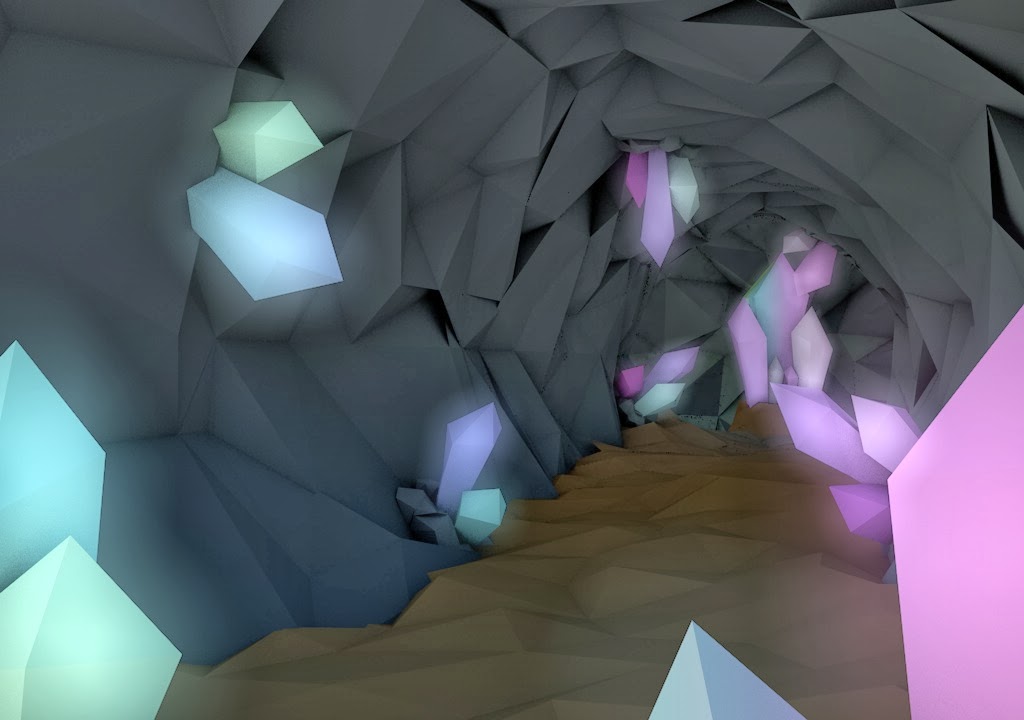
The second Crystal Cave piece was too look at how glow effects could be used within faceted 3D environments, although it looks okay in this piece I now know that there aren't many points that I will actually need it in the final piece and if I was going to do it I'd need to make the model glow in UDK, the test was useful however for using the connect and dubplicating models to create variation and make new shapes very easily in the faceted style, the rocks around the crystals for example are all made up of spheres duplicated and connected I have found this is to be a useful modelling practice within the aesthetic style.


Below are some tests I did importing these two scenes into UDK, this was done before the Pipeline test and highlighted what some of the major issues could be, issues to do with normals, and models importing correctly which I have discussed previously in the pipeline test.


Cubism and Pablo Picasso

I realise that this is a very important part of my project that I haven't yet documented on my blog so here is a big post on Cubism and how it relates to the visual style I'm going for.


Cubism and Pablo Picasso

Cubism has hugely influenced my project, particularly the works of Pablo Picasso. In many ways it is easy to directly establish visual connections between cubism and the work of artists such as Timothy J Reynolds considering the muted colours the contrast, the portrayal of depth, and the angular lines throughout that almost separate the image into different planes. Cubism is generally defined by a couple of things, firstly and most importantly is the representation of objects using simple geometric shapes and fragments, secondly another very important aspect of cubism is that cubists do not conform to any rules of art, pushing the convention of what was accepted as art was important to the cubists and had a big impact on the future development of other art movements. 

(Houses on the Hill, Pablo Picasso, 1909)


This piece, Houses on the Hill, is visually similar to new designs in faceted 3D, using muted colours, contrasting the lighter planes against the dark ones giving an illusion of depth and tying everything together by making sure even the sky has a hint of geometry.

 (Untitled, Timothy J Reynolds, approx 2012)
 

 There are two main types of cubism, Analytical Cubism focuses on portraying the subject from multiple angles, abandoning perspective to create a unique form, breaking apart the subject and then putting it back together in a new way (similar to deconstructivism). Many of the paintings shown are analytical cubism, the other type of cubism is synthetic cubism which combines many simple forms to create complexity within the image, usually combining multiple objects that create diversity within the scene. Though these two different styles cannot entirely be used to label types of cubism, considering that cubism doesn't follow any rules, many cubist artists combine these two methods.

(Dove with Green Peas, Pablo Picasso, 1911)
 
I really like the piece above because of the depth all over it, there is so much contrast between each plane and the shapes are so simple, there are really only two colours being used, creating unity within the painting.


 (Violin, glass, pipe and inkwell, Pablo Picasso, 1912)

Within my project I wish to push against the boundaries of 3D art in a similar way, in the same way that cubists didn't abide to the rules of cubism, I will probably end up ignoring a few rules of 3D modelling. The project is more about portraying things through simplistic forms and layering them together in a similar way to synthetic cubism.

(House in the Garden, Pablo Picasso, 1908)

'House in the Garden' shown above is a good example of colour in cubist art, in many cases colours are quite muted and often contrast each other. In this piece however the whole composition is depicted in tones of green. I think this method could be visually effective at portraying mood when applied to 3D and this is evident in games like Journey that represent moods in a scene very well by using lights and colour to create unity to ultimately evoke an emotion.


(The Reservoir, Pablo Picasso, 1909)

'The Reservoir' above is alike in a lot of ways to the faceted 3D style, notice the way every single shape, every plane is contrasting, the angular nature of the lines and the illusion of depth also have a part to play in making this piece really visually interesting. In many ways cubism and the faceted 3D style are the same trying to portray a landscape or scene through simplistic but well thought out works focusing on making it look visually appealing rather than realistic. 


Below are some of the other pieces of work by Picasso that have Inspired me but I haven't written about.

(Landscape, Pablo Picasso, 1908)


(Brick Factory in Tortosa, Pablo Picasso, 1909)

Final Piece Concept Art

   The following drawings demonstrate the stages of my final piece, it moves through each stage each portraying a different feeling taking the viewer on a  journey and telling a simple story through simplistic visuals.

The first scene will be a realistic room with one door that will open as the character walks toward it, this starts a cinematic in wich the viewer flies through the eye of a fractured face, representing the entering of a fractured mind, the first area is bleak representing mundaity and represents a life lived not at its full potential. All the people are seperated from each other unable to communicate are then divided further by the cracking landscape representing a big change and its impact, during the fracture some of the people will fall over representing how people we know change at important intervals in our life, and although some people are forgotten some remain.


 The viewer then flies above the mountain into the clouds going towards a light representing this new chance of hope coming after the change, although the character is alone theres something to look forward to and work towards, it should also imply a feeling of freedom where the last landscape should make the viewer feel more constricted.

As the character nears the light they realise its cold and as fractured as the landscape before and any light it emitted was a reflection or an illusion, although discovering this is dissappointing the viewer is forced to continue into the cold dark feeling alone and constricted once more.

This piece represents the most painful part of the journey were the viewer makes there way through the jagged Ice and into darkness feeling unable to move not knowing where to go but travelling on knowing that it cannot be dark forever.

The viewer then emerges in a beautiful space environment and although they are still lost there is more hope here than there was anywhere before, more to look at and endless space representing freedom of mind, there is also a light visible on a far off planet representing opurtunity and hope the viewer then moves toward this.

As the viewer approaches the light planet they can see that it is filled with many different places similar to the variation of places on earth but miniaturised, as the character gets closer to the light a city emerges with the light in the middle, the light then splits off into other many smaller lights that go seperate ways travelling all around this tiny world, this represents limitless opurtunity and that there is so much to see and do so no one should ever feel lost because there is always somewhere to go something to do and although at somepoints everything may seem dark, light is always there.

Friday, 10 January 2014

Second Supervisor Meeting

At my second supervisor meeting with Ken we talked briefly about the new direction of the project and moved on to talk in detail of what it is I'm going to be making for my final piece and what areas within pre-production I still need to address, as well as a brief discussion about my ethics form, and finally just some general advice about the honors project.

Within the pre-production of my project Ken and I agreed that an animatic in maya would be the best way to show whats going to actually happen visually and animation wise, this will allow me to fine tune the speed of the camera to try and understand what would be most effective, Ken informed me that 3 minutes is the length of time that people tend to pay attention to something before getting bored so its the optimal length for the animation.

We went on to discuss the camera in great detail as it is a very important part of the piece, I talked about how the viewer would be able to rotate the camera as they flythrough the environment and this raised some issues I hadn't addressed:
1. If the viewer can freely rotate the camera there is no way of telling they will look at the things I want them to look at, to remedy this I must create the flythrough in a way that all important elements are focused on by the player and to do this I must carefully design each scene to lead the players eye toward anything important.
2. Just because the viewer can rotate the camera doesnt mean that it is interactive, for something to be interactive the viewer must be able to actually interact with what they are viewing, this can be fixed in multiple ways, although it doesn't necessarily have to be interactive. ken suggested split pathways as a simple option for interactivity.
3. (this is the general advice) I should focus on what I can do rather than what I could learn to do, although expanding my skillset and looking into other areas is fine but I should focus on what I'm good at and not get bogged down with things like programming or sound, or in the case of the flythrough camera scripting.

We talked about the ethics form and I need to be more specific about the people I will choose for my possible focus group, it should make sense why I chose them, and I should think carefully about the questions I will ask.

Thats about it for this week, my next priority is getting my animatic done.

Animation Test

Heres a little animation test I did to experiment with how I might animate the fracturing landscape, throughout this animation I animated the objects by groups first moving the two pieces of land and the objects on top of them in a group, then the objects on top seperately, and finally the whole scene (which I probably should have animated first in hindsight) this worked quite effectively but animating in maya is quite different to animating in UDK and tests in UDK using matinee will need to be created.


Interactive Piece Layout

Stage1: Into the mind
Darkness fades into a human eye, the camera then gets closer and close then goes through the pupil and onward into the mind. 

Stage2: World broken
The camera flies over a desert landscape with people all far apart and not looking at each other, then a crack appears and splits the landscape in two separating the people, the camera then follows the crack and goes off into the clouds. 

Stage3: A chance of hope
The camera flies through the clouds towards what looks like a star as the camera gets closer it becomes apparent that it isn't a star and is actually a cold landscape as fragmented as the one before, the camera moves into a cave in an iceberg. 

Stage4: Into the darkness
The camera moves through the icy caves further and further through the spikes and into darkness. 

Stage5: Lost
The camera begins to see stars and then planets and a sun, it moves slowly at first but then starts to build up momentum toward a planet in particular. 

Stage6: Light found
The camera begins to slow as a light source is clearly visible on the planets surface, as the camera moves closer the light source begins to split and becomes many that move over the planet. 

Stage7: Limitless opportunity
A. The camera gets closer until the planet itself becomes an eye and then goes through the eye to a door that then opens and light pours out. 
B. The camera is allowed to fly freely over the planet and explore different triggerable animations. 


Idea: wherever player looks is destroyed/fractured/changed which could evoke an interesting reaction from the veiwer but may be distressing in some cases and so possibly unethical.

Interesting Video

Watched this short documentary about Matt Pyke, some of the things he said were quite inspiring and reassuring, he talks about how he tries to create something that feels very realistic even though it isn't, something that feels living and human as if you can touch it but it can only exist within the screen, he also talks about feeling like hes at the forefront of his medium and because of that hes got a clean slate in front and no legacy weighing him down enhancing his creativity.