Saturday, 9 November 2013

Inspirations 2

A game that has proved that games can be simplistic but still deeply entertaining is proteus recommended by Lynn, I had seen articles about this game previously in edge but it really needs audio and moving visuals to be effective and I will really need to play it to fully understand it, this is one of three games I will be looking at for a critical framework study.


Lynn also recommended ro.me which is a google chrome experiment that is a mixed media interactive video that uses low poly models excellent animation and audio to create a really beautiful piece of work and leaves the player to explore a low poly world filled with cube art from anyone who wishes to add to the piece, the simplistic models in this are really nicely designed and animated and really inspiring for my work, I also like the idea of a visual experience that the player is constantly moving through and only has to change the direction they are looking.

www.ro.me


New Direction

After meeting with Lynn (Parker) my project has changed to now focus more on developing a stylised aesthetic using low poly models, it may still incorporate level design, and possibly even virtual reality but right now it has been set aside. Lynn talked about the idea of cubism in 3D and what cubist's originally tried to achieve was to see an object from lots of different angles at once, this is a very interesting concept in 3D because in an environment where you can walk around the objects how can you see them from more angles than there are but perhaps through experimentation and attempting to at least somewhat achieve this goal I can develop my 3D visual style as well as work further in areas of 3D that I don't know as well as the modelling side of things.

Lynn provided a lot of useful examples of work that I'm going to list in my weekly inspirations post coming up next.

Friday, 8 November 2013

Low Poly Mountain Test

I wanted to try and work on my low poly design so I created a mountain out of a cube that I smoothed and then triangulated on maya. I took two renders of the mountain one with smooth shading turned on and another with smooth shading turned off, finally I combined them on photoshop using an overlay and reducing the opacity to 70% the results are shown below.

 without smooth shading turned on.

  with smooth shading turned on.

 smooth shading image as background with the no smooth shading image as the overlay.

no smooth shading image as background with the smooth shading image as the overlay.

The last picture is getting closer to the sort of aesthetic I want to be able to achieve though it might further be improved by a simple texture, more lights, ambient occlusion, or a shader which I will further explore in coming weeks, I would also like to look into achieving this aesthetic in a game engine like UDK.

Tuesday, 5 November 2013

Developing My Critical Framework

 knowing that my subject area will be focused around level design I developed a critical framework, the book that helped me most when creating this framework was "Game Level Design" it is a work in progress and subject to change but this diagram should help me to analyse games and determine what is good and bad about them and what combinations of the criteria work well together.


Although I said I would review a journal article for my next theory objective I felt this was more important to get atleast a first draft done early so instead my next theory objective is to write a review of a journal (probably on immersion or player experience).

abstract environment test

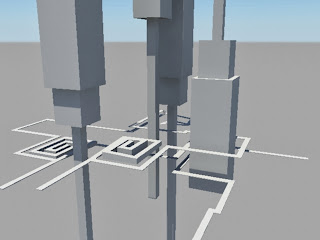
Initially I started trying to model optical illusions in 3D and it may be possible but only with shaders and no field of view, and either way they arent that well suited to 3D game environments where they player can walk around, I may explore this further but unless I'm definitely going down an abstract 3D route there doesn't seem to be much point.

So I moved on to create an abstract 3D trying to create an Escher sort of feel, unfortuneately this turned out quite badly quite early due to poor composition, lack of context, and no real goal in mind for the level.

after seeing all the low poly games that are being made recently I had a look into low poly art, it had interested me before in previous projects but I had never looked into it beyond a few artists, some fantastic low poly art can be found on this webpage:

http://www.pinterest.com/justinclaypool/low-poly-3d-art/

This inspired me to create some assets in the most simplistic way by using the same shape over and over again, the first piece I created was a building made of one cube duplicated and re-scaled as shown below


due to this looking quite nice in a simplistic way I moved onto my next test which was mountains made entirely out of one pyramid that I duplicated and re-scaled in the same way.

I found this to be an interesting way to work, because of the speed in which designs can be mocked up and how easy it is to pick up where detail is lacking, I found it similar to adjusting tonal values in a painting by looking at it grayscaled or while squinting.

I then started to create some slightly more detailed assets but still trying to stay as low poly as possible and use simple shapes, below is a tree and some rocks.


By now I felt I had enough pieces to create a small environment so I attempted to make a low poly landscape with two cars on a road.

 
when I was happy with the rough composition I started adding more of the assets I had already created to make a mock up scene.

Its incredible how much easier it is to manipulate a scene and get the composition the way you want it when working with low poly models, it also allowed me to focus more on some of my weak points (e.g. making good use of outliner). I then moved onto colouring the environment, toying with the lighting and adding little details like clouds (made entirely out of spheres).


and finally I went into photoshop to make a few minor adjustments and create the final image.


This style of 3D is ideal for mocking up levels because of the speed at which assets can be produced, altogether this piece probably took around 7 hours and if I were to create another one I'm certain I could do it much faster. As for the low poly style I do really like it and think there is a trend recently leaning towards it, in the same way architecture has slowly trended from highly detailed buildings to simpler designs that look cleaner, minimalist and more modern. I'm not sure if I will pursue this style yet but its a possibility.

My next practical objective is to create a higher poly 3D piece by using someone elses artwork.


Friday, 1 November 2013

Inspirations 1

I have started to explore the route of surreal 3D environments with very simple geometric structures one game that is entirely focused on surrealism is back to bed by Team 1UP shown below.

The Environment in this game looks incredible, the colours, the lighting, the optical illusions, and props all convey the feeling that the player is in an amalgamation of surrealist paintings combining the visual style of René Magritte, salvador dali, and MC Escher. The game is beautiful and I can't wait to play it and experiment with similar techniques in a 3D environment, although I imagine that it will be difficult to recreate some of the optical illusions but thats what i need to find out.

Another Game that uses 3D surreal environments is Dream, the player takes on the role of howard philips in his lucid dreams, the game is largely puzzle based but is largely focused on the beautiful dream world visuals which change throughout.


this sort of environment could definitely be achievable considering my current 3D skills and has some really fantastic environmental animation which I am quite interested in.

The final Inspiration this week is the game Kairo, the game is created using very simple geometric shapes and often one texture per room but the game is still visually interesting and the levels are fun for the player to navigate through and solve puzzles as they go.

I believe that for my final project I can achieve a higher level of detail than that which is present in kairo but at the same time I could use similar 3D modelling techniques to create level tests to find out if the layout is fun and perhaps inform the visual style by using simple textures and seeing what works.


By looking at some of the 4th years blogs from last year I was inspired and shown the different possibilities there are for blog posts, I noted the things that I felt were most relevant to do for my subject.

-weekly inspirations post
-post work to be reviewed on forums
-use someone elses concept art to create a 3D environment
-level design tests
-lighting tests
-texturing tests
-map tests
-modular building tests

I also feel its a good idea to create aims for my next blog post at the end of each blogpost rather than posting a plan of action, this should keep me working more regularly

my aim for my next post is to:
1. create a level design test
2. read over some of the journals I have found